
NSAIDs: A Daily Kidney Punch
Over the years, I’ve been surprised by how many people casually tell me that they take ibuprofen (or any other NSAID) every day as part of their routine. Friends, that’s not a good strategy for long-term kidney health. There are some concerning cardiovascular side effects of long-term use of NSAIDs, too.
This is on my mind because, a) I’m writing a book on how to live healthy and well as long as possible that has a supplement chapter, and b) I had someone have tummy troubles taking Nutradisc while we were doing decompression for a two-level disc herniation (the discs got much better–we actually got a rare “after” MRI that showed huge changes). I swapped her supplements and took the Nutradisc home for myself.
You see, back in April I started having some foot pain on the medial/arch side of my foot from popping out of the Peloton pedals (side note — I just hit my 700th ride). Foot pain can be hard to beat since the tissue is being loaded with every step. It got so bad at one point that I sent myself for an X-ray to make sure I didn’t have a stress fracture, which, thankfully, I didn’t.
I’d hit the hurty bits with the laser once or twice a week; it would get better-ish, and then I’d go into the weekend not really thinking about it. But by Sunday afternoon, I’d be visibly limping if I was on my feet too much.
One of the active ingredients in Nutradisc is curcumin, the yellow/orange spice found in many curries. It has anti-inflammatory properties that approach NSAIDs, but without the hit to the kidneys.
After six months of gimping around every weekend, I started taking a handful of Nutradisc a couple of times a day, and lo and behold, my foot is 90% better as I write this.
There are others, too: Boswellia is another supplement shown to help with arthritis pain. And in the spirit of the impending season, it should be known that boswellia’s other name is frankincense.
I’m not saying supplements should replace drugs–but in some cases, like daily inflammation/pain control, I think a case can be made that hammering your body with NSAIDs can be counterproductive to long-term health.
More than pain control
Another supplement that’s gaining public attention is berberine. Berberine’s main function as a supplement is to lower fasting blood glucose, which can improve HbA1c and insulin resistance. It’s not as powerful as, say, metformin, but if you have low-grade metabolic syndrome, it might be worth investigating. There are also some small improvements seen in cholesterol associated with berberine use. I recommend Thorne as a trusted brand.
Examine.com is a subscription-based service that researches the quality and quantity of evidence for supplements, and here’s a snapshot from their site on berberine. The letter grades indicate the quality of the studies:
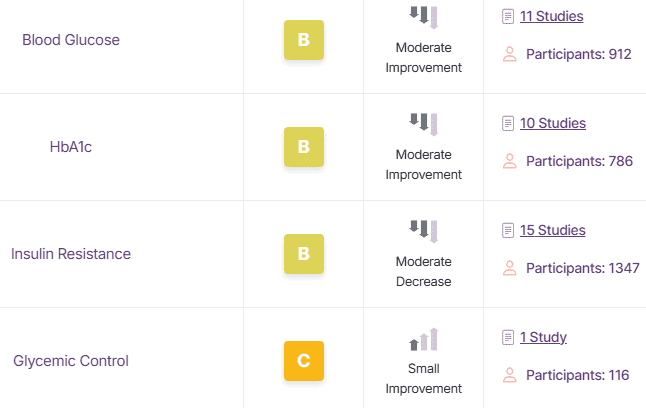
In my upcoming book, Immortal Till You Die, I’ll have a supplements-worth-considering chapter, and the above will be in the “honorable mention” category. And I know I’ve been saying I’m shooting for a January publication date, but I think it might take a little longer — because I’ve decided to do an audiobook version, too, and I’m going to narrate it myself.
That probably means coming to the office on the weekends when it’s quiet and talking until I can’t stand to hear my own voice any longer. But reading it out loud will be one last quality control check on the manuscript, which I should finish this week. I’m coasting in at a little over 80,000 words.
One last thing about supplements–I have a Fullscript store, so you can buy supplements at a discount, and they’re having a Black Friday sale from November 27 until December 2, where everything will be 20% off (I keep everything at 10% off year-round, so the prices are pretty good all the time). So if any of this interests you, go make an account and wait until the end of the month to stock up.
Until next time,
Doc G
